Showing posts with label controversial post. Show all posts

Controversial Post: Wearing Military Garments?


Military uniforms have influenced civilian fashion since uniforms have existed! There's something about the design and meaning of military uniforms that continues to inspire people all over the world. But who can wear them, and when is it appropriate?

Fashion Revolution 2016 - Goals

Flashback Summer - Fashion Revolution 2016: Goals

Today officially ends Fashion Revolution week, but it doesn't end our responsibility to bring about change!  This week has helped me think through my abilities and weaknesses in my skill as a maker, and I think I can move forward as a better creator and consumer in the fashion industry.

My personal goals to take from this week are:

Flashback Summer - Fashion Revolution 2016: Goals

What about you?  Have you had any epiphanies or thought-provoking discoveries this week?  Are there any habits you have as a maker and/or consumer that you would like to work on this year?

Fashion Revolution 2016 - Skill Up

Flashback Summer - Fashion Revolution 2016: Skill Up

Making clothes is a black hole of skills.  It seems to me that the more I know about sewing... the more I realize I have yet to learn.  There are so many kinds of sewing, so many types of garments, so many skills to learn!

While it sometimes seems a little overwhelming, I'm actually really okay with it.  I love learning, and what better field to pick than one that can provide a lifetime of learning?!


It's important to me to master my craft, to become exceptional at what I do.  It means that the clothes I make will be more durable and longer-lasting, thus being better uses of resources.  It also means I will be more likely to keep these garments.  Do any of you know the pain of deciding what to do with a garment you spent hours upon hours making?!  You do NOT just throw it out without a second thought!  If it must go, you find a good home for it or repurpose it into something equally as awesome.  It means something to you.


Flashback Summer - Fashion Revolution 2016: Skill Up

There are a lot of areas in which I want to improve my skills.  My top three are in tailoring (suits specifically), lingerie, and sewing knits.  I'll be working on these specifically this year.

What areas of "makery" would you like to skill up in this year?  

Fashion Revolution 2016 - I Mend My Clothes

Flashback Summer - Fashion Revolution 2016: I Mend My Clothes

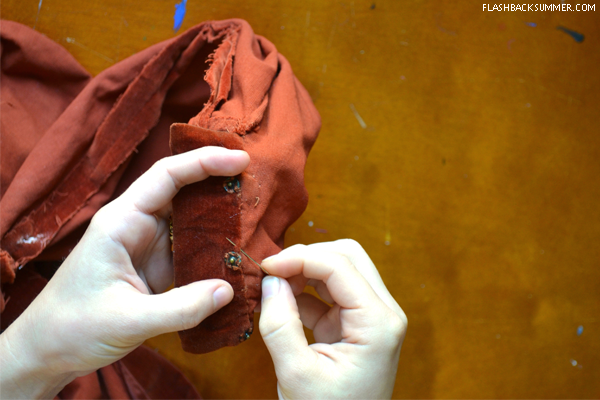
Mending one of those things that I have fallen into by necessity through wearing vintage.  If you've worn true vintage, I'm sure you have had the experience of a popped seam, fallen hem, or loose button that needed to be fixed.  (I've even had those happen while I was wearing them... which is why I recommend all vintage wearers carry a tiny sewing kit in their purse at all times, ha!)

Not many people know how to mend nowadays!  While people of yesteryear always mended their clothing ("make do and mend" was a real thing!), I can honestly say I never thought to mend clothing until I wore vintage.  If a shirt got a hole in it when I was younger, I figured it was ruined and usually threw it out.  No longer!

Flashback Summer - Fashion Revolution 2016: I Mend My Clothes

Fixing garments, I've found, is a unique skill.  It's not exactly the same as sewing a garment.  It takes some ingenuity and creativity!

The 1930s and 40s were especially good at clever mending fixes due to poverty and war shortages.  They used mending tape embellishments to fix torn buttonholes and cover other flaws.  They embroidered over flaws and dyed garments to cover stains.  If you'd like some vintage mending inspiration, here are a few of my favorite examples and resources:

1940s Darning from Colette
"How to Mend After Moth"
"How to Patch an Overall" by Mrs. Sew and Sew

Flashback Summer - Fashion Revolution 2016: I Mend My Clothes

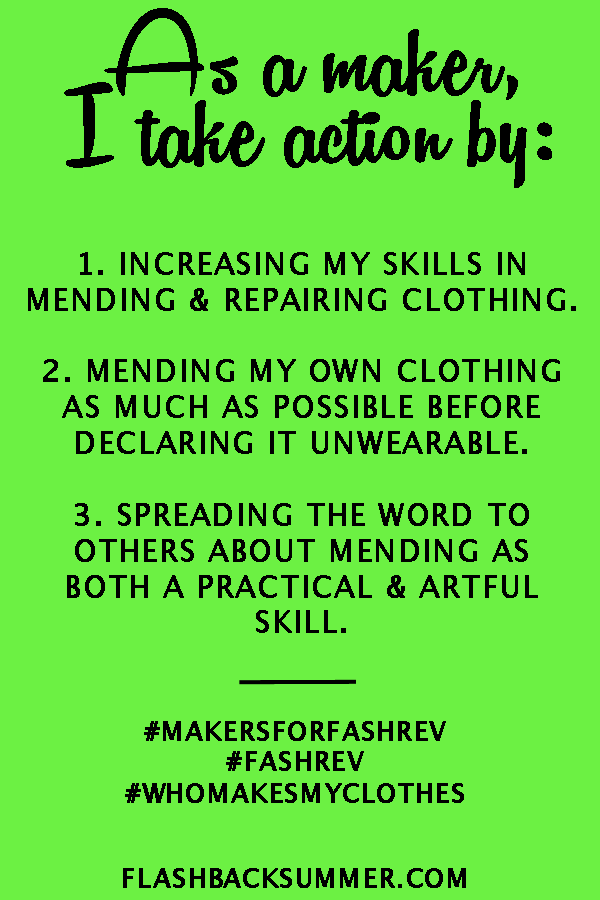
So, here are my action steps for today:

Flashback Summer - Fashion Revolution 2016: I Mend My Clothes


How do you guys feel about mending?  Have you learned any useful tips or have any favorite mending resources?

Fashion Revolution 2016 - By Hand

It's day two of Fashion Revolution 2016, and the theme is:


Flashback Summer: Fashion Revolution 2016 - By Hand

I didn't realize this until recently, but all garments are made by hand, in the sense that a human being is manipulating the fabric and working at a sewing machine of some kind or sewing with a needle and thread.  I used to think that clothing, especially cheap clothing, was made entirely by machine, much like most of the other products we buy nowadays.  However, that's not the case with clothing!

Every item we wear has been sewn by a person.

Flashback Summer: Fashion Revolution 2016 - By Hand

Have you ever had a clothing item that you didn't think much about until you tried to make one yourself?  For me, that has been a t-shirt.  I figured that, as the seemingly cheapest  and most plentiful clothing item available, a t-shirt had to be an easy, throw-away type garment to make.

It is no such thing!

Flashback Summer: Fashion Revolution 2016 - By Hand

Geez, after learning about it, there is so much more to a t-shirt than I had ever realized!  Now I value t-shirts so much more, knowing all the types of machine and sewing skills that goes into each one.

As vintage wearers, many of us bemoan the loss of those gorgeous, intricate details that clothing used to have that has been cut out of most modern clothing by profitability and the throw-away mind set.  As we wear our vintage clothing and invest in these more expensive pieces, as we sew and include our own "slow fashion" details, we are reminding people around us of what clothing could be if we started to really care about it again instead of treating it as a fad that is to be thrown out in a few months.

Thinking about how every clothing item is made by hand, here are my takeaways for the day:


Flashback Summer: Fashion Revolution 2016 - By Hand

Is there a clothing-making skill or garment that seemed simple to you into you delved into it?  How did it change your perspective?

How do you think we can balance the needs of lower-budget consumers with the needs of clothing artisans to be paid fairly for their work?

Fashion Revolution 2016 - I Make My Clothes

Flashback Summer - Fashion Revolution 2016 - Makers

It's Fashion Revolution week!


This is the week dedicated to looking specifically at the issues plaguing the clothing industry and how we as everyday Janes and Joes can go about changing things for the better.  The week is hosted by Fashion Revolution, a non-profit organization created in the wake of the 2013 Rana Plaza Complex collapse that killed over 1,100 garment industry workers and injured over 2,500.  This event awakened many of us in the world to the reality of abuse and greed in the clothing supply chain, and we began looking at the brands we love, the factories that produce clothing, and our own habits to see how we can make things better.


We believe that fashion can be made in a safe, clean and beautiful way. Where creativity, quality, environment and people are valued equally.   - Fashion Revolution


But some of you may be like me... Mostly, you make your clothes. You buy vintage.  You make do and mend.  You're already doing many of the things that are recommended for revolutionizing the industry.  But that doesn't mean we're off the hook!  We can do better, and we can help others do better!


I'm pleased to say that In the Folds and Petit à Petit already thought of this, and this week they're coming at this fashion revolution from a maker's viewpoint.  I'm joining in and will be posting on IG and on the blog this week on the issue, and I'll be adding in a vintage-wearer's two cents while I'm at it!


(I strongly urge you to read the post from In the Folds about the meaning of this week. It's got an overview, explanation, and list of resources you can check out to learn more about the garment industry.)


Every day this week there will be a "prompt" posted by In the Folds on an aspect of the revolution.  I'm sharing my thoughts, as well as weaving in my ideas as a vintage wearer.  Today is:


Flashback Summer - Fashion Revolution 2016 - Makers

Although not all of you are sewists, I know that many of you do identify.   You may also be a crocheter, knitter, weaver, milliner, etc.  There are many ways to make clothes!  Whether you have made all of your wardrobe or just a few accessories, making your own clothing is an amazing way to revolutionize the fashion industry.

Sewing has allowed me to rebel against the standardized sizing of fashion in the U.S. that doesn't generally fit me as a petite woman.  It has also given me the freedom to wear what I want instead of having to choose from what is available. It also makes the vintage styles I love more affordable and durable, rather than buying original vintage all the time.  Making my own clothing is just the best!


However, making my own clothing doesn't let me off the hook when it comes to revolutionizing the garment industry.


I do still buy some things off the rack.  Socks, t-shirts, and underwear especially.  Not to mention, I also use fabric made in factories.  Just because I step into the clothing production chain at a sooner point than others doesn't mean I don't play a part in it.


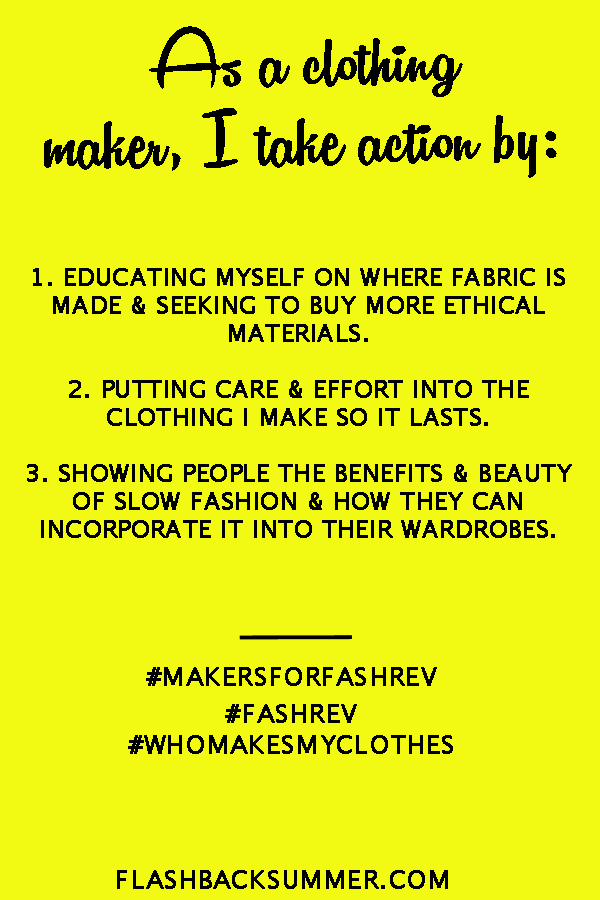
So, as a maker, I still have a responsibility in this cause.  Here are my personal three action steps relating to my role as a clothing maker.


Flashback Summer - Fashion Revolution 2016 - Makers

What are your thoughts on this Fashion Revolution Week?  If you are a clothing maker, how can you still impact change in the clothing industry?  Do you have any sources of secondhand or ethically made fabric you especially love?

Controversial Post: Who Can Clap for That Wrap?

As we've been going through the "Clap for That Wrap" series, I've noticed that some of you have expressed trepidation at trying new head wrap styles because you're afraid of culturally appropriating styles from other cultures.

I won't lie, I find this interesting, and I'm ashamed I didn't think it enough of an issue to address right off! But, hey, better late than never, right?  Let's dig into this together!


@flashbacksummer
Two things I think we can all agree on to start (or the vast, vast majority of us at the very least can agree on), is that 1.) The question is not whether or not each of us can or cannot wear head wraps, but which head wraps we can rightly wear, and 2.) Religious head wear (such as specifically Muslim or Sikh styles) should only be worn by the people adhering to those religions or ideals.

Now that we've got that settled, let's get into the not-so-clear part of head wrapping: Who can wear which wraps?


I didn't feel I could bring as well-rounded and diverse a viewpoint that this discussion requires, so I asked for the opinions of others to aid in the discussion.  I've also pulled quotes from articles on the subject and included a few more resources at the bottom for your further reading enjoyment and learning!


@flashbacksummer
What are we afraid of?

"I wonder about the history of some vintage styles. They have definitely been inspired by cultures other than dominant Western ones, and even if I'm referencing vintage style, I wonder about cultural appropriation."  - Kim Koin


I think most of us are afraid to try certain wraps we're unsure of because we don't want to insult people.  We don't want to appropriate from other cultures, and we do want to respect other people groups.  We don't want to act out of ignorance and hurt others.  I hope Dasha's words will encourage you as we go further:


"But the fact that we all pause and think, 'How can I do this [headwrap] justice?' is a step in the right direction, as opposed to blindly doing things without facing our own ignorance... We're all trying not to offend each other."   - Dasha Guyton


"... head coverings will always have a place in society." - Dasha Guyton

Discussion is important, and just asking the question is a show of maturity and awareness.


What wraps are in question?


Most of us probably don't have a problem with anyone wearing a "Rosie the Riveter" style wrap or such styles that are just plain "vintagey" and Western or worn for utility.  From what I can tell, many wraps in question for you guys are inspired by black/African (differentiating between these is a whole other conversation we won't get into!) or even Middle Eastern styles.  The way the fabric itself is wrapped may be the "iffy" part for some of us, or sometimes the print on the fabric (such as kente cloth or wax prints) may make some of us feel uneasy about trying them.  We may even be concerned after watching wrap tutorial videos if the person in them doesn't look like us.  


Who needs to question their wrap styles?


Unless you can clearly, unambiguously connect yourself to a particular wrap style as far as culture or history goes (such as being a Nigerian wearing a Nigerian wrap), then you should do an evaluation before wearing.  This evaluation is not limited to a particular race, culture or people.  Anyone borrowing a wrap style that can be attributed to another culture should ask themselves if it is alright to wear, just as a starting point. The answer may differ from situation to situation or person to person, but most of us are going to need to start by asking, "Am I the person to wear this wrap?"


So how do I evaluate?


"El-Amin Naeem argues that the practice of headwrapping came before some religions, for practical reasons, such as keeping hair clean and blocking sand from the nose and mouth. 'No one group owns it. You decide for yourself,' El-Amin Naeem says." - from this article


"You decide for yourself." - Zarinah El-Amin Naeem
My top 5 tips for deciding which head wraps to wear:

1.  Do research.  Is this wrap style originating from a certain people group, religion, or era?  Does the fabric's print have a name or signify something?


2. If it originates from a certain group, has that group expressed their opinion on "outsiders" wearing the style?  Is there someone from that people group you can ask for insight, or articles that may share their thoughts on it?  (If you discover through several resources that they really don't want "outsiders" wearing it... don't do it.  If it seems ambiguous, use your best judgement and keep evaluating with the questions below.)


3. Are you at least knowledgeable enough about the wrap or fabric to be able to converse about it and show a basic understanding of its roots?  Honestly, if you aren't willing to do a five minute google search on a wrap or fabric that belongs to another culture, you don't deserve to wear it. Yep, I'll be that blunt. 


4. If it's not exactly a traditional wrap, is it a version "inspired by" or very similar to a wrap claimed by a cultural group?  Is there a version you can buy that would support the community it originates from?  If not, are you willing to support a company that has knocked it off without giving credit?


5. What do designers say?  Look at shops that sell head wraps.  Do they feature anyone that looks like you wearing their products?  If not, is there any information on their social media profiles or website that express their views on people outside their group buying and wearing their products?   (I found this IG post from the feed of @thewraplife to be a good example.)


6.  Do you ROCK IT?!  After all the evaluating, this is the question it all comes down to... Does it flatter you?  Do you feel downright amazing in it?! If so, rock it!


While I have my ways of evaluating for myself which wrap styles I wear, I also wanted to share some tips and thoughts from others on how they decide what wraps they should and should not don:


"Head wraps have existed in all cultures for aeons, but we have to be mindful that cultural relativism actually shifts over time. What projected one way decades ago projects in another today. I think it's today we are concerned with, not yesterday--even as this is a vintage clothing discussion site. We don't live in the past, and regarding racism and sexism, we sure as hell wouldn't want to."

- Robin Edgerton

"IMO, as long as you are not wearing a culturally significant textile or wearing a religious turban, I think it's ok to wrap a scarf or fabric and tie it on your head. I generally stick to solid fabrics or pattern scarves that are in no way culturally tied."  

- Aly Rose of Aly Rose Vintage


Mary of Verily Merrily Mary
"One thing Westerners and Western culture can do is stop acting like they found a novel fashion piece whenever they are rocking African items, head wrap or otherwise. It happens so often and is so offensive. Arbitrary 'tribal print' headscarves and clothing sold in stores like Forever 21 sometimes have them with patterns that are African and, of course, Africa is not given the due credit when it is advertised. It’s just a cool 'new' trend. Knowing the history of the continent and how it has been (and continues to be) pillaged and colonized, the very least they can do is acknowledge and respect the origin of those fabrics and buy from African designers. At the end of the day, people are going to do what they want to do, but I would prefer that non-African people wear African fabrics for reasons other than 'it looks cool.' That will challenge people to actually research the history of what they are wearing, perhaps even to the point that they would rather not wear it out of respect. When in doubt, my advice is to wear the fabric if you’re invited by someone in the culture to do so (wedding, etc.)."
- Mary of Verily Merrily Mary


@alyrosevintage
"It can be done right by doing your homework. If I'm going to showcase my love for Indian culture, African culture etc, I'm going know the appropriate names and origins. This doesn't mean I don't have the right to style it or wear it in a nontraditional way but being prepared to say, 'Oh thank you, I love this kente print too,' as opposed to saying, 'African,' shows your respect for its roots...
[Black women], too, have to ask ourselves if it would be offensive to our culture or anyone else's. After all, Africans and African-Americans have a tumultuous history. We have to face the elephant in the room and ask ourselves if we are selling out by mimicking the style of ancestors who sold us into slavery?"
- Dasha Guyton

"I don't think it's appropriation if you are not wearing a religious turban, and you are taking care to wear an ethnic wrap with respect to the culture. Especially if you're supporting the local designers of color.  Rock your head wrap!"  

- Nisha Miles

"Don’t wear a wrap just so you can say you’re 'pro-black' or something… Don’t do it because you have a political reason.  Do it because you really like it, because you appreciate the ability it gives you in creating a new look for you."  

- Aziza Lynn, aka "The Bargain Beauty"


"The bigger the knot, the better you feel." - Aziza Lynn, aka The Bargain Beauty
"It's hard to decide what is appropriation and what is not, especially in the arts (fashion included) because being influenced by other ideas and cultures is natural. I think one of the big red flags that we can all agree on is taking culture (in this case fashion) from another culture and using it without regard for the context or claiming it as your own. Women from all over the world and from many parts of history have used a variety of wraps and ties all throughout history to keep their hair neat and off of their neck, as well as for religious and modesty reasons. I think the head wrap is a challenging issue because it's not strictly used by one culture or only for religious dress. I'm not sure what the right answer is for head wraps, but it seems to me like the fact that we're having the conversation means that everyone's intentions are in the right place."  
- Allison Dyke

So, readers, what about you?  Are there head wrap styles you feel nervous about trying?  How do you decide which wraps to wear?  Has any of these people's insight changed your thoughts on what you would wear?


Extra reading:

How A Head Wrap Taught Me An Important Lesson About Professionalism And Race
The Curious History of "Tribal" Prints
IG conversation on @thewraplife feed
Black America, Please Stop Appropriating African Clothing and Tribal Marks
In Order for Black Americans to Appropriate African Culture...
Culture Is Not Costume
Under wraps: Style savvy Muslim women turn to turbans
You're Wearing That Out?: My Family's Disdain for Headwraps and Why I'm Embracing Them
The African American Woman's Headwrap: Unwinding the Symbols

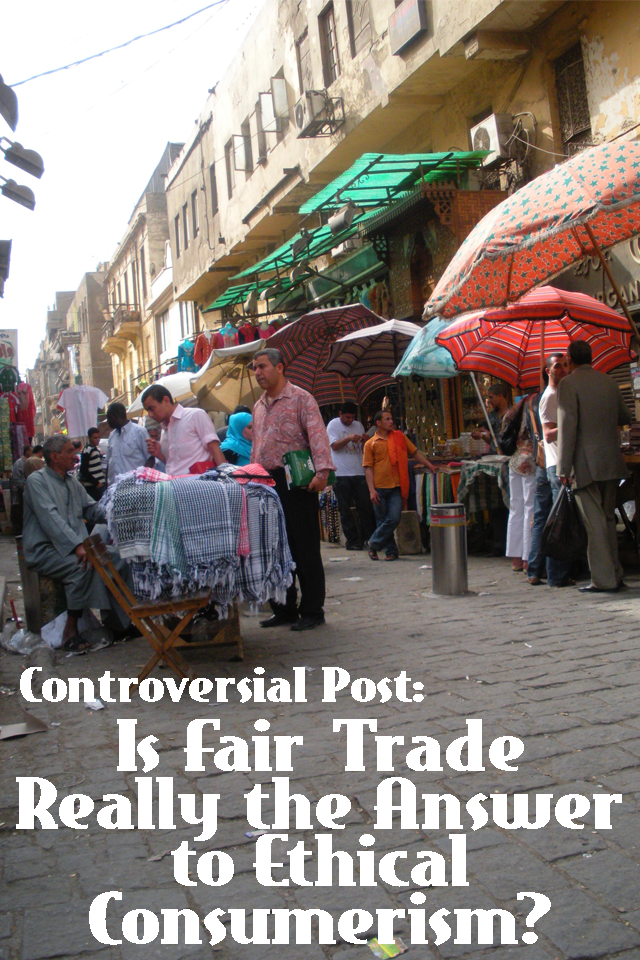
Controversial Post: Is Fair Trade Really the Answer to Ethical Consumerism?

Flashback Summer - Controversial Post: Is Fair Trade Really the Answer to Ethical Consumerism?

Today I'm happy to share a guest post by Mary of Verily Merrily Mary. I love her blog because she boldly tackles hard issues and facilitates lots of good discussion, and today she's here to start a conversation about something many of us fashion lovers have pondered long and hard: ethical consumerism and fair trade.


It’s no secret that sweatshops have injustice threaded into the fabrics they produce. It is also no secret that virtually every piece of clothing that makes its way into the West is stitched with these fabrics. Along with these articles of clothing, the production of shoes and accessories are almost always problematic. But three years ago, I came across what I perceived to be the solution to sweatshops, a solution that would be one step forward in the fight for social justice in the supply and mass production of merchandise.

The CEO of a certain company came to my university to present their mission and how their bags and accessories were different from what the general public would typically buy. She mentioned that her company is fair trade certified, one that trains artisans abroad to make products for their company. Unlike sweatshops, workers in “Third World Countries” work fair hours and receive fair compensation for their labor. No child is exploited. No person receives cheap pay. Essentially, they go with the “teach a man to fish” approach and the lives of the workers are changed for good.

Many people believe that companies like these are the solution to ending the existence of sweatshops as we know it. They are the beacon of hope for workers in poorer countries that could otherwise be exploited or jobless. And as such, companies like these urge those of us in the West to do the best we can to purchase their products. Others go a step further and say that we should make it a goal to live off of fair trade products only. And by doing this, we are living a truly ethical consumer lifestyle.

On the surface, this sounds pleasant and inspiring, an undertaking that makes shopping an act of social justice instead of your everyday, run-of-the-mill consumerism. But if anyone is familiar with fair trade clothing, one of the things that makes them distinctly different from sweatshop clothing is their price. Since the artisans are getting their fair share and suppliers are not being grossly ripped off of the natural resources needed to make the products, the retail price tends to be expensive. For example, what would normally be a $15 pair of pants could be $40 or even more. Your average consumer would likely have a hard time affording it. When looking at the United States alone, 25% to 66% of those living in America are in the middle class. 45 million other Americans live below the poverty line. A fair trade only lifestyle would be especially hard to keep up for those in this demographic.

Since Fair Trade companies are their own entity and are not affiliated with sweatshops, they typically do not get involved in the social justice issues that contribute to making sweatshops a more ethical place to work. According to this article, since the United States is the most demanding of cheap clothing from sweatshops, it is up to U.S. department stores who sell their products to make sure that children are not exploited, factories are safe, and people earn the wage that they deserve. Fortunately, there are some companies that are putting pressure on their supply chains to make sure workers are treated fairly. All this to say, it takes more than purchases from fair trade companies to advocate for those who work in sweatshops.

Often times, conversations about sweatshops are talked about outside of the United States and the Western world. Reality is that there are exploitative sweatshops inside of the United States despite the fact that we have laws in the United States that protect workers. Obviously, purchasing from fair trade companies whose suppliers are foreign has no connection to making sure sweatshops in U.S. soil have just conditions and a just wage.
Clearly, the situation concerning social justice in the textile industry is multifaceted. While purchasing from fair trade companies contributes positively to the movement of justice, a lot more is required for an overhaul of the entire industry where exploitation is non-existent.

Given what you know about fair trade and sweatshops, what are your thoughts on social justice in textile factories? What are some initiatives or movements that could contribute to a better working conditions for textile workers and an affordable price for those who buy from them?


About the Blogger

Mary is a 20-something millennial trying to survive the post-grad life much like other millennials are doing. She is a bi-tribal (Efik & Igbo) Nigerian-Canadian-American third culture kid (TCK) with Nigeria as her place of birth and sunny, Southern California as her current home. She is a storyteller and a writing coach at Verily Merrily Mary who uses her stories and insights to spark cultural conversations. As a writing coach she equips and emboldens difference makers to use the power of the written word to affect change.

Controversial Post: War Commemoration

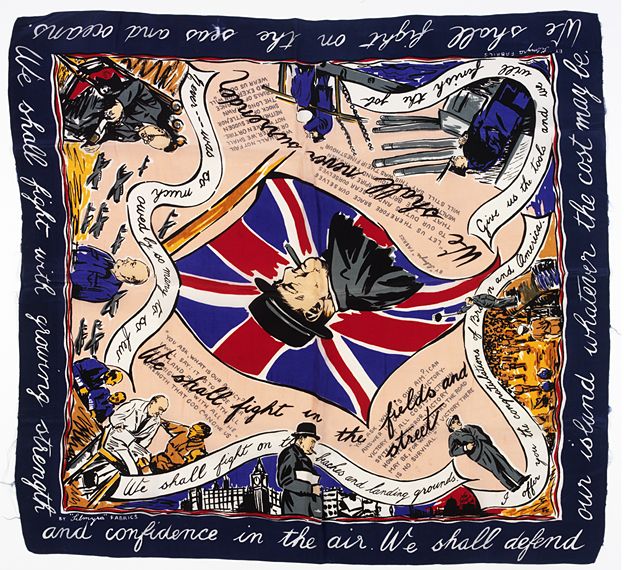
The other week, I posted on FB about one of my Holy Grail fabric prints (which I ended up finding and buying! I'll be posting about it soon!).  This 1940s fabric's motif is celebrating the victories of the Allied forces and, in 1940s terms, saying why the Axis powers sucked.

I wondered on the FB post why no one makes fabrics like this anymore. Obviously, there could be lots of reasons, but my cousin, a veteran, brought up a good point, "Because it is politically incorrect to celebrate military victories anymore."

I don't know if you've noticed, but the 1940s was all about celebrating military victories, on both sides. Some of the items are straight-up propaganda, but I've seen examples of fabrics, posters, dishes, clothing, even parties, all highlighting a victory or triumph in battle.  (Like all the D-Day stuff we see around!)


Flashback Summer: Controversial Post - War Commemoration
kimono, 1940’s. collection of yoku tanaka.
photo by nakagawa tadaaki/ARTEC studio. Source.

Flashback Summer: Controversial Post - War Commemoration
Now, without getting into politics and drawing party lines, I wanted to hear your views on this.  Especially since I know you readers are from all over the world, what do you think?  I mean, imagine. What if someone in your country made novelty print clothing or jewelry commemorating important combat victories? Would you feel comfortable wearing it?  Why or why not?

On one side, I can see wearing these items as perfectly fine.  It's a good thing to celebrate justice and freedom, and sometimes those things are achieved only through warfare.  It pays respect to the men and women that fought to win those victories and reminds us of the sacrifice and cost paid for ideals we value.

On the other hand, war is a terrible thing.  Especially in the midst of it, it can be hard to determine who is "right" or "just."  War wrecks peoples' lives, and to wear a piece celebrating it disrespects the people who have paid dearly because of war's effect in their lives.  It trivializes it.

Would you/do you wear war-themed items from the 30s and 40s?  Would you wear newer versions celebrating modern victories? What factors do you think are different now than they were during WW2 that may affect your opinion? 


Flashback Summer: Controversial Post - War Commemoration
source


Like I said, I'm not opening up a discussion for whether certain wars are justified, or if certain leaders/countries are doing the right thing.  I'm just asking, assuming your country had a very important victory that meant a lot to you, would you celebrate it through clothing or jewelry?  Why or why not?

Just a warning, I love for all of you to feel comfortable sharing your opinion and even welcome disagreement, but I will not tolerate blatant hatefulness or slandering of specific countries, cultures or military personnel of any kind.  Globalizing comments that lump all of a certain group of people into one shallow category are not acceptable and will be removed.

Controversial Post: Why Is Vintage So White? - Part 2

Flashback Summer: Controversial Post - Why Is Vintage so White? - Part 2

This is a continuation of a controversial post published yesterday.  If you haven't already, please go to the first post to learn the intention behind creating this post and the first half of the questions for the panel.  Feel free to join in the discussion below with your own respectful viewpoints!

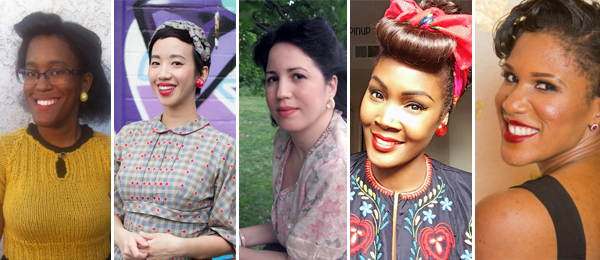
As a refresher, here are the lovely ladies on the panel!


Carla - blogger at "Tiny Angry Crafts" | Nora - blogger at "Nora Finds" | Daffny - blogger at "A Vintage Nerd" | Angelique Noire - pinup model | Candace - pinup model

Since you've already read the background info for this pair of controversial posts, let's get back to the questions!

Does there seem to be a common theme of why others of your race don't wear vintage? (This may also tie into the culture you identify with, which is often connected to race. Also, maybe there isn't a common theme! That's okay to say, too!) 

Angelique: There are many Black people that wear vintage or styles based on the 1940s/50s.  They don't typically frequent events catering to the vintage community, but that doesn't mean they are non-existent...If you look, you can see the influence of classic 40s/50s style being interpreted in a modern way by many Black women. It's just a matter of how you interpret their style. For example, when you see a Caucasian woman wearing a turban, midi skirt, a button down blouse with cat eyeliner and red lips, many can see the influence of a popular 1940s/50s fashion style. You see the exact same style on a Black women, people automatically think she is doing something solely based on African influence because of the turban. I have so many Black girls and women tell me that I am their inspiration because they adore the style. 

Candace: Two words: Not cool. It’s okay to like and listen to Beyonce and Nikki Minaj, it’s okay to listen to R&B and hip-hop but don’t you dare wear seam-stockings and say how much you love Dita von Teese and Dean Martin. Those two don’t mix. I think it has to do with not being brave enough to be who you are. I love artists like Erykah Badu, Janelle Monae, and India.Arie they are neo-soul R&B singers, and are brave enough to wear their natural hair and to be fully clothed and show talent and not skin. I like women like that. Unfortunately, mainstream has dominated so much so that if you wear vintage or want to you get frowned upon. Especially, for the younger girls they find it hard to and sacrifice who they are and want to be because of looks and bad mouthing. When has liking James Mason and Elvis ever been a crime? Why is it horrible to be classy and leave mystery behind?


Carla: I've asked some of my friends why don't they want to dress vintage, and the response is usually either "I don't see anyone who looks like me doing it." , "I don't want to get teased " "Oh, my people didn't dress nice back then." And I've seen some people posting on sites 'Oh white kids who emulate that style are harkening a caricature of the past, and are erasing the struggles of PoC.'

Carla - source
 Nora: What we mainly call vintage pieces are of Western style, but vintage actually encompasses a whole bunch of historical pieces whether they are vintage batik, vintage kimono, or vintage cheongsams. But what we wear nowadays are mostly American/European vintage so a lot of minorities don't feel like they can relate. My grandma grew up in Indonesia under Dutch colonization so she wore the kind of vintage we wear now. But if you are from mainland China I can understand that you don't "get" vintage. Also, Chinese people (or maybe all Asians) have this believe that new is always better, so they tend to not like the idea of wearing second hand clothes. I think it's because vintage clothing reminds them of the past, which in my culture is usually something we don't like to talk about. We Chinese like to move on with things and improve ourselves, so past sometimes just feels like something that holds you back.

Daffny: I find those within the Latino culture here in New York think its cool what I do and do not judge me for it at all.
Nora - source
Are there elements of the vintage community that are, at the least, not friendly toward people of color or, at the worst, just plain insulting? What are they? If you could, how would you change these things? (Meaning, how would you prefer these situations be handled?) 

Nora: I personally do not think there are things that are insulting. But I'm probably not easily insulted. Heck, it's a think line between appreciate a culture and adopting it as a costume. What about this year's Met Gala?! Is it offensive to wear chopsticks in your hair or wear cheongsams?! I don't think any one person can represent a whole racial group to say what's offensive and what's not. Obviously Edwardian pieces are less minority friendly because they simply aren't a part of our history, but the Western fashion did make its way to other countries pretty early in the 1920s (like mogas or Japanese flappers).

Candace: There have been a few guys on my FB page (Black Pinup Models) that have said some down right vile things that I had to delete and ban. Some see black women as exotic creatures and that’s it, no brains, no personality, I had to get rid of them as well. We’re more than that.

Carla: I haven't personally experienced this, but I've heard stories of Black people being treated rudely at rockabilly festivals. I find this entire situation very odd, considering rockabilly was a subset of rock and roll, which has roots in African American blues music.


Angelique:   I think it is downright insulting when people wear clothing and/accessories with the Confederate Flag. Either they are wearing it because they are absolutely ignorant of the hate and racism it was associated with, or these individual straight up could care less about exercising empathy. Also what I mentioned about lack of diversity in publications, and photographers who choose to not photograph Black women is also insulting. 

Daffny: I don't think the vintage community is unfriendly to anyone who is different. We have black women, gay women, disabled women like me and everyone is quite friendly and sweet. Its one of the reasons I love this community so much.

Daffny & her lovely kids - source
How would you encourage other people of color in embracing their own personal style?

Daffny: I would encourage someone from my culture to embrace the beauty and the history of the past and to have fun with it. I would tell them to add their own dash of salsa to the mix and make it dazzle!

Nora: I would encourage them to do some research on their own history, on other people's history, and just generally on fashion history to find what they like and what they don't. I don't identify myself with just one racial/cultural group so I don't feel like I need to limit myself on wearing only one type of clothing. I would encourage people to find their own style whether or not that is vintage.

Candace: One of my favorite lines from a song from my favorite bands, Halestorm has a song “Sick Individual” the chorus says, “I’m doing thing called whatever the f**k I want…” I love that attitude… [but] It is hard to do because growing up we’re told what to say and do and not do certain things because we’ll appear as something to others and so on. But it gets tiring, and you get fed up with so you have to have that attitude...I’ve been adapting that attitude because I’m tired with trying to please everyone, it’s exhausting. I think everyone should live by that. If wearing seam stocking and cat eyeliner makes you feel better, happier, prettier go ahead and do it. Why should you sacrifice your happiness for someone else? I will not sacrifice my polka dots and pearls for anyone!

Candace
What practical things can members of the white majority do to support other races in the vintage community? 

Nora: I don't think there is any discrimination to be honest. I always feel like people appreciate my style and myself and don't think I'm wearing vintage to imitate white people or I'm simply costuming. I think the most important thing is to treat everyone the same way. Give compliments and be genuine - when someone looks lovely, then tell them but don't be patronising or don't sound surprised.

Daffny: I think those who aren't from other cultures just make sure that they are welcoming and friendly to anyone who comes into the community irregardless of their culture. You cannot go wrong by being nice!

Candace: Just keep supporting. I have such wonderful supporters who aren’t black quite a few of them are white believe it or not and I’m very happy. I was a little worried I felt like I would be alienating them with the name Black Pinups, but I think most of them are like me, they like it because it’s pinup, it’s a great product/photo and they want to see me and others do well.

Carla: Feature more PoC of the eras in beauty posts and the like. (I'm working on this during the summer) Talk to PoC who dress vintage, and compliment their style.

Angelique Noire - source
What other things do you feel need to be said pertaining to this issue? Is there anything else that could help readers better grasp your experience?

Daffny: I think it is important to know that not all Latinos in America are Mexican. The Mexican culture is a beautiful one but we also come from Europe, South and Central America, and the Caribbean. We come in all colors, shapes, and sizes. We have blonde hair and red hair, we come tall/slender and round/curvy, with freckles, with dark skin and pale skin. Don't judge a book by its cover. You never know who may be and so therefore I encourage you to just ask.
  Candace: I hope that people will be more open if they’re not towards black history especially in the entertainment industry. I had a post of black history female pioneers and I was happy to see how many of my white followers were interested in learning, it was awesome. I’m glad more people are wanting to learn more. I love to learn about any history not just mine but everyone’s so I’m hoping it continues.


For more information on Asian culture & vintage, check out Nora's more in-depth post, "Why Don't Asians Wear Vintage?"