

Showing posts with label history. Show all posts
Women's Equality Day & The Skirted Soldier
26 August 2019
Influence of the Korean War on Fashion
29 July 2019
 |
| Street scene in Seoul, September 1953 |
The Korean War is sometimes referred to as "The Forgotten War" in the U.S. It wasn't highly publicized like World War II and Vietnam, and it was relatively short, lasting from 1950-1953. However, it was one of the more impactful conflicts that still affects international relations today. The rate of civilian casualties in the war was higher than during World War II and Vietnam as well, and another generation of American GIs experienced war in a place they likely never would have ventured to otherwise.
(Read a summarized timeline of the war here.)
The conflict also affected the people back home. When troops went to war, many of them were traveling overseas for the first time in their lives. They stopped in various countries along the way to the front, oftentimes buying souvenirs and garments for loved ones back home. These little pieces from their travels made their way into the wardrobes of mothers, wives, girlfriends, and sisters all across America.
Home Sweet Mountain Home Air Force Base
25 September 2018

In this post I've linked to my Spoonflower shop. I'm not officially partnering with Spoonflower, but if you buy any of my fabric designs I do receive a percentage of the profits as a designer. This money helps me buy coffee, fabric, hats and supports my blogging habit; you all know how it goes!
I've long complained about the uninspired quality of modern military-themed fabrics. Particularly compared to the creative and beautiful patriotic prints of the 1940s, they're pretty icky and there aren't a lot of options.
It was finally time to stop complaining and DO something about it!
C-Street Car Show for the Kilties
24 May 2016


Yesterday I stumbled upon the Car Show for the Kilties here in Springfield. My friend and I were stopping at Springfield's one vintage store (Decades on Commercial Street), and the whole area was blocked off for a car show and the weekly city market! Springfield doesn't have many vintage events at all... except for classic car shows! We dominate those, and there are quite a lot of them throughout the year here.


This car show was a fundraiser for the Kilties, a girls' drum and bugle corps at my alma mater, Central High School. The Kilties were started at Central in 1926, and I always thought they were pretty awesome. I was glad to help out the group!

I grabbed Jacob and we came back later to take it all in. My dad's side of the family is very into classic car restoration, so I've been going to car shows my whole life. However, the extent of my knowledge is pretty much being able to determine the decade a car is from and admiring the shiny chrome.
When I go to car shows, I always pick out my favorite car that I would buy if money and practicality were no object. So let's have a virtual car show! Which one would you pick?


So what's your favorite car? Which one would you like to own?
1942 - "Modern Clothing Depends on Chemical Science"
09 May 2016

This article is from the third book in a multi-volume series entitled "Building America." First published in 1936, my sister found this updated version from 1942 being given away in her university library. The subject matter is fantastic, the covers beautiful, and the colors match mine and Jacob's home decor, so she snatched them and gave them to me!
The book series covers many aspects of American life such as farming, heavy industry, war and peace, education, culture, healthcare, and even clothing. It's a really interesting look at America and it's history from a 1942 perspective.
I found this article on the chemical science behind the "new" fabrics of the day especially fascinating. Buttons made of milk, mercerization, and the connection between viscose and rayon... just a few of the interesting tidbits explored in the article! It was a bit tricky to try to scan a hardback book, so I've typed out the complete article for your reading pleasure below:
Modern Clothing Depends on Chemical Science
Chemical products are important in the process of making the clothes we wear. Before wool and silk, cotton and linen, can be used by the spinner and the weaver they must go through many chemical processes. And within the past thirty years, the chemist has perfected a new set of textile fibres--the rayons.
The chemist develops ways to free fibres such as wool and silk from foreign matter and impurities of many kinds before they go to the spinner. These fibres are washed with specially made soap-like compounds until they are clean and pure.
 |
| Left photo: Winding rayon threads on spools, after which these threads are woven into cloth or clothing. Rayon, a chemical product, is made in somewhat the same way as Cellophane. Right photo: Testing a sample of dye to be used on a print fabric. This modern chemist has produced hundreds of shades which our forefathers never saw in garments. |
Fibres and fabrics are bleached chemically for use as "white goods" or to prepare them for the dyeing process. Many years ago bleaching was done by soaking fibre or cloth in vinegar or buttermilk, or by spreading out linen and cotton in the sun. But as the production of these fires increased with the use of power looms, a more practical way was needed. It was then that chemical bleaches were first used. At first, bleaching powders were made by combining chlorine with lime and water. Although for many years the textile industry used this method for whitening materials, it was not quite satisfactory since this bleaching process sometimes weakened the fibers and made them unfit for use. Today other chemical compounds are used which make the chlorine harmless after it has done its bleaching work.
In the dyeing of cloth the chemist performs another valuable service. At first, as explained earlier, the only coloring materials used were those gotten from natural products. Now the chemist makes many thousands of colors from coal-tar. The manufacture of these synthetic dyes is an interesting and complicated chemical procedure.
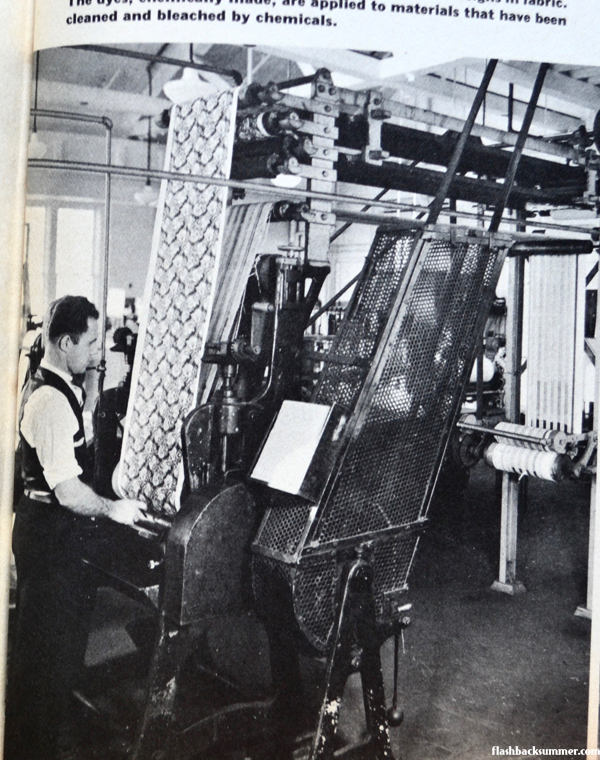 |
| Trying out dyes on a machine that prints designs in fabric. The dyes, chemically made, are applied to materials that have been cleaned and bleached by chemicals. |
We often see the word "mercerized" used in connection with cotton fabrics. Mercerization is a chemical process which makes cotton resemble more expensive material. This is done by putting woven fabric in a solution of caustic soda. When the soda is rinsed out the fabric has a silkier and more attractive-looking finish.
One of the marvels of modern chemistry as applied to the manufacture of clothing is that of rayon. Rayon is a textile fibre chemically produced from cellulose which is the main element in the cells of all plants and trees. Spruce, the wood used to make Cellophane, is also used in making rayon.
As early as 1664, scientists were seeking a man-made fibre. In 1884, a Frenchman named Count Hilaire de Chardonnet studied the silkworm and the chemical composition of the mulberry leaf on which the silkworm feeds. He found that the silkworm's food was made up mainly of cellulose, and it was possible to "digest" it chemically and then to force the cellulose solution through a tiny hole and solidify it. He called his method the nitro-cellulose process. This man-made fibre was introduced in the United States in 1910 and was sold as "artificial silk," "glos," "synthetic silk," and under many other names. In 1924, manufacturers agreed on the name "rayon" for all man-made fibre based on cellulose. They have been known by the name ever since, although the chemical process used by de Chardonnet is no longer used in the United States.
Today, rayon is made from spruce wood and cotton fibre by dissolving the cellulose in them with chemicals. This forms a thick liquid known as viscose. After a series of chemical baths the viscose is forced through tiny holes from which it drips in filaments as fine as silk fibre. These filaments are then twisted together to make thread or yarn.
 |
| In the clothing of this man and woman are chemical products such as rayon in the gown and tie, and a coating for the heels of shoes that prevents "scuffing." |
Rayon has become a very important textile material, and in 1937 one billion yards of rayon material went into dresses, underwear, piece goods and linings.
A large variety of chemical products are used to make leather for our shoes, belts, gloves, purses, wallets, and luggage. Chemistry has also produced many substitutes for leather and tanning.
The very buttons on our clothing are now being made of substitute materials by means of chemical processes. The waste skim-milk of the dairy supplies the chemist with casein from which he makes a plastic material that can be molded into buttons.
Perhaps we most often think of chemistry as applied to clothing when we use a cleaning fluid. The most common chemicals used are benzine, gasoline, and naphtha. These are inflammable, and recently chemists have found safe substitutes for them.
Did you learn anything new from this article? Will it affect how you view or care for your vintage clothing?
Edwardian Jewelry
21 February 2016
 |
| Edwardian diamond engagement ring in platinum, circa 1920 |
However, Edwardian jewelry is an easy way to add the beautiful delicacy of that era into a modern-vintage wardrobe! The beautiful pieces from this period are timelessly beautiful, so they fit with any era you may be particularly fond of. For this post I'm using examples of jewelry from vintagediamondring.com, so if there's anything you REALLY love... it's not a museum piece; it's actually possible to add to your wardrobe!
The Edwardian era is named for King Edward of Britain. His reign began in 1901, and this is considered the beginning of the Edwardian period, with dates ranging from 1914-1920 being considered the end of the period.
 |
| Edwardian sapphire and diamond ring set in platinum, circa 1920s |
 |
| Antique filigree diamond brooch, circa 1920s |
Scrolls, wreaths, ribbons, and flower garlands in flowing arrangements are common in Edwardian jewelry, too. Oftentimes there's an overall dainty feeling in Edwardian pieces, sometimes achieved through filigree or other delicate work.
 |
| Edwardian pearl and diamond ring in platinum |
This is a sponsored post. For more information about my sponsorship practices, check out my policies page.
Princess Fawzia of Egypt
23 November 2015
"Twice in my life, I lost the crown. Once I was the queen of Iran, and
once I was the princess [of Egypt]. It’s all gone now. It
doesn’t matter.”
Princess Fawzia Fuad of Egypt is one of those incredible women that has all but faded into history. Born in Alexandria, Egypt in 1921, Fawzia was the daughter of King Fuad of Egypt and his second wife, Nazli Sabri. (In Egypt it is acceptable to have several wives.) She grew up in luxury, cared for by an English governess and educated abroad in Switzerland. At this time, Egypt was precariously balanced between Egyptian monarchical and British colonial rule.
Fawzia was touted as one of the most gorgeous women in the world, and she was fluent in English, French, and Arabic. A Sunni Muslim Egyptian who spent time in European society, she enjoyed fashion and never donned the hijab. After returning to Egypt, she felt confined by the rules and regulations of being a royal in a time when everyday Egyptian women were beginning to experience new freedoms.

In 1939, the 17-year-old Fawzia was given in marriage to Mohammed Reza, the crown prince of Iran. The marriage was a diplomatic arrangement between two countries. Egypt was given access and authority over a British-controlled region through Fawzia's new place in the Iranian royal family, and Iran's new monarchy received legitimacy from the century-old Egyptian monarchy. Her marriage is best remembered by many modern Egyptians for being a Sunni-Shiite union.
Fawzia and Mohammed were married and lived in Tehran. They had one daughter and seemed happy for a while. Mohammed became the Shah of Iran, and Fawzia became Empress. However, Fawzia soon lost her love for life and began to hate all things Persian. Rumors swirled about her husband's philandering, Fawzia found Persian difficult to learn, and relationships with her in-laws were tense. She was sick often, and her father demanded a divorce after seeing her frailty during a visit. She left Iran, never to return. The world followed their marital drama through magazines such as The Times.
She later married an Egyptian aristocrat and had two more children. The 1952-53 military coup by Nasser, however, overthrew the Egyptian monarchy and British colonial rule, completely turning Fawzia's world upside down. Her brother, now the king, escaped to Italy and never returned to Egypt, but Fawzia and her family quietly moved to a home in Alexandria and began to fade further and further from the public eye.
Fawzia lived in anonymity for the rest of her life. In 1976, Anwar Sadat (the president of Egypt at the time) extended a reconciliatory invitation to Fawzia's daughter and her family to stay at a palace in Alexandria. They all visited Fawzia's villa, and Fawzia said she would like to return the visit by calling on them. This was shocking, for the palace that belonged to Sadat was once Fawzia's childhood home. She had not been there in 24 years. During her visit, her former servants met her with tears and embraces.
Throughout the coups and revolutions, Fawzia quietly remained in Egypt. The onetime princess of Egypt and Empress of Iran passed away in July of 2013 as President Morsi was being deposed by the Egyptian military. She must have had special insight into the rise and fall of Egyptian leaders over the years and once remarked:
"When you visit the tombs of kings and queens, you see they leave everything behind, even the crowns.” {tweet this}
Further reading:
The Slow Disappearance of Queen Fawzia - New York Times Magazine
Princess Fawzia Fuad of Egypt - The Telegraph
Princess Fawzia: the Beautiful, Sad Rose of the Nile - Egyptian Chronicles blog
Princess Fawzia Fuad of Egypt is one of those incredible women that has all but faded into history. Born in Alexandria, Egypt in 1921, Fawzia was the daughter of King Fuad of Egypt and his second wife, Nazli Sabri. (In Egypt it is acceptable to have several wives.) She grew up in luxury, cared for by an English governess and educated abroad in Switzerland. At this time, Egypt was precariously balanced between Egyptian monarchical and British colonial rule.
 |
| source |
Fawzia was touted as one of the most gorgeous women in the world, and she was fluent in English, French, and Arabic. A Sunni Muslim Egyptian who spent time in European society, she enjoyed fashion and never donned the hijab. After returning to Egypt, she felt confined by the rules and regulations of being a royal in a time when everyday Egyptian women were beginning to experience new freedoms.
 |
| source |
 |
| King Farouk, his sister Fawzia, and her husband the Shah - source |
 |
| Empress Fawzia and her daughter, Shahnaz - source |
She later married an Egyptian aristocrat and had two more children. The 1952-53 military coup by Nasser, however, overthrew the Egyptian monarchy and British colonial rule, completely turning Fawzia's world upside down. Her brother, now the king, escaped to Italy and never returned to Egypt, but Fawzia and her family quietly moved to a home in Alexandria and began to fade further and further from the public eye.
 |
| source |
Fawzia lived in anonymity for the rest of her life. In 1976, Anwar Sadat (the president of Egypt at the time) extended a reconciliatory invitation to Fawzia's daughter and her family to stay at a palace in Alexandria. They all visited Fawzia's villa, and Fawzia said she would like to return the visit by calling on them. This was shocking, for the palace that belonged to Sadat was once Fawzia's childhood home. She had not been there in 24 years. During her visit, her former servants met her with tears and embraces.
 |
| Fawzia and her second husband, Ismail |
Throughout the coups and revolutions, Fawzia quietly remained in Egypt. The onetime princess of Egypt and Empress of Iran passed away in July of 2013 as President Morsi was being deposed by the Egyptian military. She must have had special insight into the rise and fall of Egyptian leaders over the years and once remarked:
"When you visit the tombs of kings and queens, you see they leave everything behind, even the crowns.” {tweet this}
Further reading:
The Slow Disappearance of Queen Fawzia - New York Times Magazine
Princess Fawzia Fuad of Egypt - The Telegraph
Princess Fawzia: the Beautiful, Sad Rose of the Nile - Egyptian Chronicles blog
American Farming: Then and Now
13 October 2015

It may surprise you to find out, but I LOVE learning about farms. Farming is one of the oldest ways of life, and it's hugely important to society. (Remember history class? It takes a surplus of food to get to the art part of a culture!)
Last Friday I had the opportunity to tour three local farms with people from the Missouri Farm Bureau. Like I said, I love farms, so I was pumped!
As I looked around the farms and heard from the farmers and their families, I was astounded at how high-tech farming has become and all the science farmers incorporate in their work. I think a lot of us think of "Green Acres" or "Little House on the Prairie" when we think of farms, but that's not true for most of them today! I learned SO MUCH on this trip that I can't possibly post it all here!
In the earlier part of the 20th century, scientists were afraid the world would run out of food as the population grew. With their farming methods of the day, we would have had a food crisis by now. However, major advancements have been made to make farming more efficient, safer, and cheaper to provide us with affordable food.
To show how far farming has come and its importance in history, here are some farm facts from the 1940s:
Farming Then
In 1940, 18% of the American workforce is employed in farming. One farmer supplied an average of almost 11 people with food.
In 1940, 58% of farms had at least one car, 33% had electricity, and only 25% had a phone.
 |
| source |
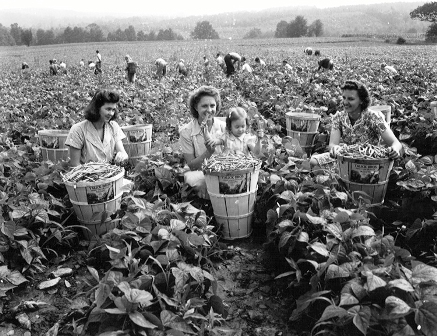
In 1941, the National Victory Garden program is launched in the United States. This initiative encouraged civilians to start their own gardens to allow more food to be sent to soldiers overseas. It was a big part of preventing food shortages during the war.

1942-1949: Food price regulation and rationing are in place. Victory gardens become an important way to supplement rationed food options. Women take the place of men in doing a lot of farm work while the men are at war. They get a taste of freedom from working outside the home, and their work is seen as a patriotic duty.
 |
| source |
Facts found at this source.
 |
| source |
Farming Now
As of 2012, only 1% of the American workforce works in farming, fishing, or forestry. Less than 2% of Americans live on farms. (source)
The average American farm is still family owned but has increased to 433 acres. (source)
 |
| calves at the Samek dairy farm |
Nowadays, about 41% of the U.S. is farmland. We still export a lot of our food, and U.S. farmers produce 46% of the world’s soybeans, 41% of the world’s corn, 20.5% of the world’s cotton and 13% of the world’s wheat. (source)
Increased technology has made farmland more productive than ever. One farmer now supplies food for 144 people! (source)
 |
| Mr. Drake, a row crop farmer |
Things I Learned About Farming
There is an increasingly large gap between farmers and consumers. It didn't used to be this way. Back in the day, nearly everyone had a family member that lived on a farm, or they lived on a farm already! Agricultural basic knowledge was commonplace. Nowadays, that just isn't true. Most Americans don't know why farmers do what they do or where their food comes from. I think it's important to bridge this gap to build trust between farmers and consumers and to create the healthiest, safest food for our communities.
 |
| Drake Farm |
The vast majority of farmers strive to produce good food using safe practices. Most of them live on the land they farm, drink the water from the wells beneath their fields, and eat the food they produce. They want safe food for their consumers and for their own families.
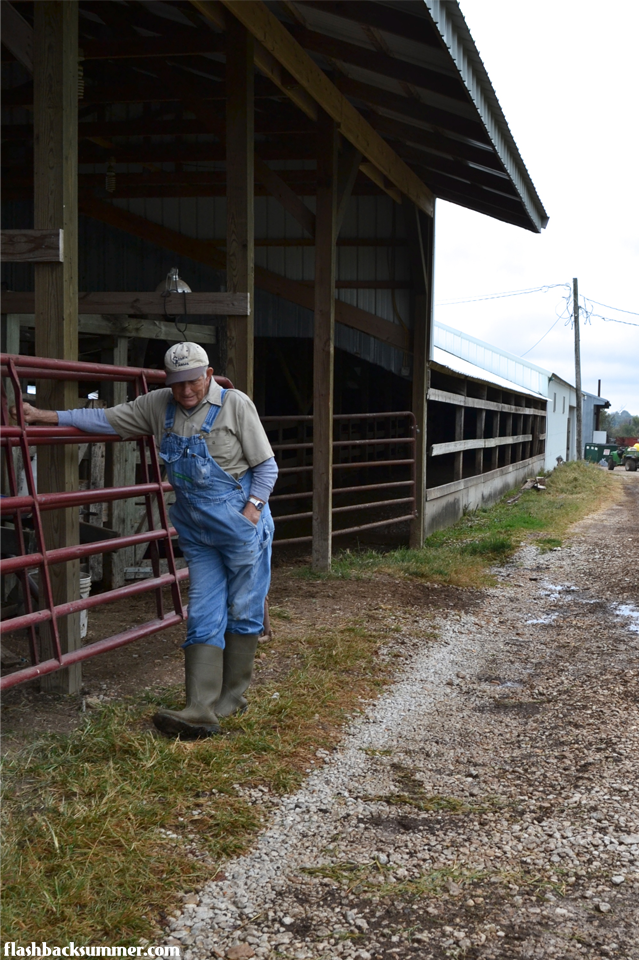 |
| Mr. Samek, the dairyman at Samek Farm, a multi-generational family farm |
There are very, very few farmers that don't care about their animals. Besides being a moral thing to do, taking proper care of animals and providing for their needs produces better food. (In fact, the tags you see on cows' ears are like cow Fit Bits! They track the cow's activity and health on a daily basis to ensure they are doing well. Farmers are very serious about the health of their animals.)
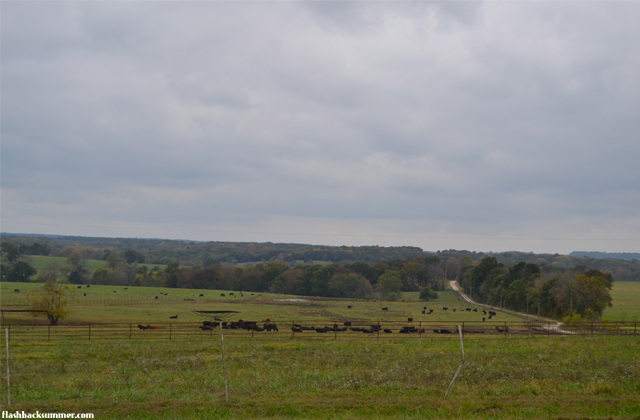 |
| Cribbs beef farm |
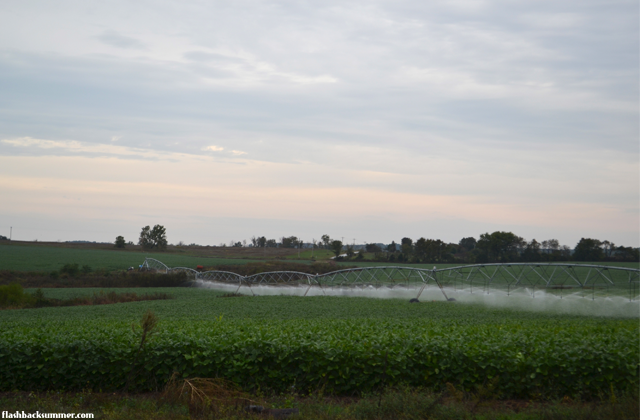
Farming technology is crazy advanced! There are combines that literally drive themselves, GPS systems in tractors, and fine-tuned machinery that makes farming hugely efficient. These technologies also allow farmers to use only as much water or chemical as is absolutely needed in a field, no more and no less. Agriculture is more precise and accurate than it has ever been.
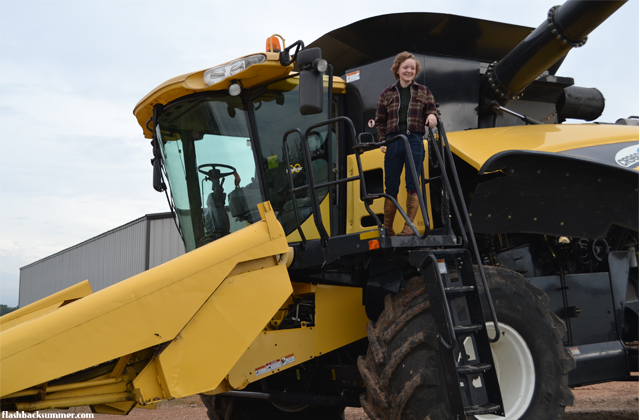 |
| Yes, this is me on a combine. It was awesome. |
Technology and scientific advancement needs to be learned about, not feared. There's a lot of talk of GMOs, pesticides, and other chemicals these days. While it is important to be educated on these topics, I think we need to make more room for farmers to explain their processes before we freak out. A lot of GMOs allow farmers to use less chemicals. The row crop farmer we talked to, Trent, said they use less than a quart of many herbicides and pesticides on their land per acre; most of what you see being sprayed on a field is water. The dairy farmer explained how the hormones they use to help cows produce more milk are already present in cow's bodies; they aren't mutant-juice created in a lab, and there's no detectable difference in the milk. Take time to learn about these issues, but try to hear from a real farmer, too. The media can make things seem scary when, in reality, they aren't. Farmers and their families eat their produce, too; they aren't just faceless corporate farms trying to make a profit. Learn from them!
 |
| Mr. Cribbs (in the green hat) teaching us the ways of beef farming |
Do any of you have ancestors that were farmers back in the day? What were your ideas of farmers and farming before this post? Have you ever gotten the chance to go to a farm or talk to a farmer about his work?
I learned far too much to include in this post, so if you have questions, feel free to ask! We can find answers together!
For more learning, check out these sites:
Growing a Nation: The Story of American Agriculture
1941 Agriculture Video
Missouri Farm Bureau website
A Sharecropper's Daughter
18 August 2015
 |
| my grandmother, Mary Lou |
I recently re-ran across one of my favorite parts of my family's history, and I wanted to share it with you guys today! You may remember me mentioning my mother's side of the family was made up of sharecroppers back in the day and were very poor. This affected my family a lot, and I remember my grandmother, Mary Lou, telling me stories of her childhood when I was a kid, before she passed away in 2003. Before she passed away, my grandma worked with my aunt to tell a biography of her mother, my great-grandma Julia. My aunt has compiled it into an online version entitled "A Sharecropper's Daughter" that's about as long as 4-5 blog posts, and you can read it here.
It's not only interesting reading, but there are lots of family photos and documents! If you've wondered what poorer people in the 1900s-50s wore, you'll find pictures of them here. This story will cover lots of things that aren't usually covered in our sources of vintage knowledge: poverty in the South among whites, single parenting, mental illness, and giving to others despite having almost nothing.
Here are some of my favorite snippets from the story:
"It seemed everyone born in the south was destined to have three names, families would name their children for friends and relatives whether it made sense or not. Julia's father Walter, however was different. He was called Babe until he was four years old, when his mother told him he had to have a Christian name. He told her he wanted to be called Walter and that was that. No middle name. No relative to be remembered. Just Walter."
"Julia was ready to leave the house with such high hopes for higher learning. When her cousin came for her, her mother made the statement that set Julia Ann on a path of determination and a goal of seeking knowledge for the rest of her life, 'You're not going.' Hardly believing her ears, Julia fought back the tears. She was going to be denied her one chance for education. Her mother told her she was needed at home more than she needed an education...But the desire to learn still burned like a molten ember that was forever being fanned to burn brightly for the rest of her days."
 |
| Granny "Anner" Block |
"[Granny Block] and Nicholas set up housekeeping in a little house among the trees and raised a handful of children. During their married lives, Nicholas would, as many men in the community did at the time, frequent the local 'road house' (with the reputation that went with it). One fateful night, Granny Block had had enough of being alone with the kids and surmising where Nicholas was, she reached for the pistol, walked to the 'road house' and ordered Nicholas to 'Come out, blast ya!' He refused, she insisted, so she told him she was going to start blasting through the door if he didn't show himself. So the other men (probably not wanting to be identified) made Nicholas leave and Granny (all five feet of her) marched him the long way home with the gun nestled in the middle of his back."
"Later, Julia would learn to hunt ducks, geese and squirrels herself to help fill the larder for her family. She lived through two world wars, the time of ration stamps, saccharin, no coffee, doing without, riding buses as an only means of transportation and through it all good times and bad, she never lost her love for helping people or her sense of humor. She left a legacy of Christian love and compassion for all who knew her. She lives in the lives of her children, grandchildren, and great grandchildren who will keep her pioneering and need-to-know spirit both in learning and striving to new heights, alive in whatever their undertaking and horizons they cross."
Click to read the whole story...
 |
| Julia |
Subscribe to:
Posts (Atom)


